

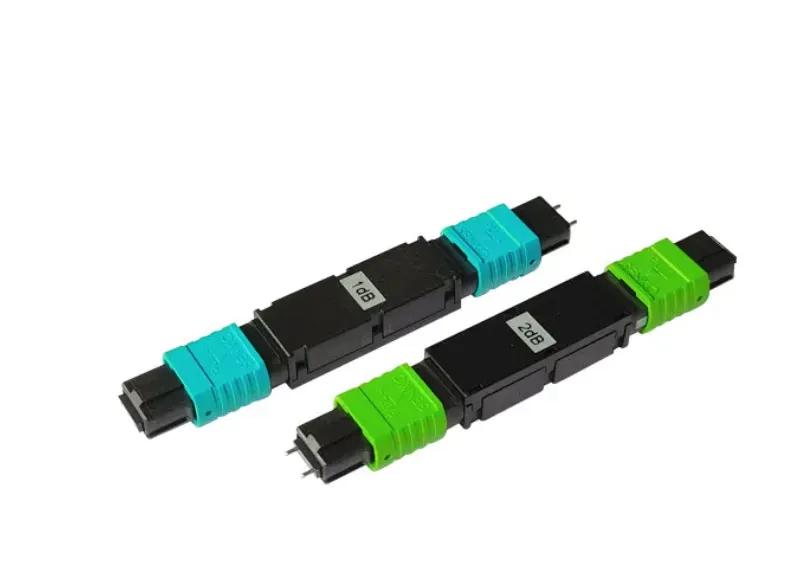
In optical testing for multimode systems, signal adjustment is sometimes a requirement due to stronger power conditions than those that are normally required in daily use. The Multimode Attenuator is a tool that helps to decrease the power of an optical signal to a required level for testing the receiver in a stable condition. The attenuation levels are fixed for OM1, OM2, OM3, and OM4 types of fibers. The connectors are of different types, such as LC, SC, FC, ST, and MPO.
In multimode systems, attenuation is not a requirement for daily use. However, sometimes it is required for testing and troubleshooting purposes. The attenuation is helpful when engineers want to test the optical receivers before the devices are connected to a network.
Passive Monitoring Without Interrupting Live Traffic
In the context of network monitoring, the visibility of the signal needs to be tapped into without disrupting the actual communication. MTP/MPO TAP Cassettes are designed to function as passive devices, which means they can split the optical signals into two paths. One path remains live, and the other is routed to the monitoring equipment.
Since the MTP/MPO TAP Cassettes function as passive devices, they remain invisible to the actual network. No IP address is required, and no power is needed. As such, these devices can be used in applications where the actual network needs to remain secure and uninterrupted for long periods.
Practical Use in Parallel Fiber Links
A Multimode Attenuator is best applied in high-speed parallel optics. Male-to-female multimode designs using MPO attenuation are the best option in 40G and 100G optical transmission networks.
This is helpful during the process of checking the manufacture and during any troubleshooting. It is also helpful to ensure clearer measurements when comparing the performance with different ports.
Monitoring Through Modular Cassette Design
In high-density optical systems, it is important to ensure that the design is compatible with the existing rack design. MTP/MPO TAP Cassettes ensure this by allowing the cassettes to be installed within the existing structure of the patch panel. It is possible to install several cassettes within one rack unit.
This modularity allows for the installation of monitoring points wherever required without the need to redevelop the fiber backbone. It also allows for future expansion in case more monitored links are required in the future.
Fiber Types and Split Ratios for Monitoring
The Multimode Attenuator requires a matching fiber type since multimode wavelengths have different operations compared to single-mode networks. Multimode fibers have test wavelengths of 850/1300nm, with attenuation ranging from 0 dB to 30 dB in 1 dB increments, and accuracy specified for lower and higher attenuation ranges.
The MTP/MPO TAP Cassettes for monitoring networks have different split ratios such as 50:50, 60:40, 70:30, and 80:20, depending on the proportion of signal allocated for monitoring compared to live transmission.
Compact Solutions for Dense Optical Environments
The Multimode Attenuator has been created to allow for multiple matings while maintaining stability in performance, with a mating life of up to 50 matings and low insertion change.
MTP/MPO TAP Cassettes have cassette designs to allow multiple monitoring modules to fit within one rack space, which can help to keep things organized in a dense fiber environment.
Conclusion
Reliable multimode optical preparation often depends on controlled signal reduction together with passive monitoring visibility across active links. Arkoptics includes these solutions for environments where attenuation accuracy and modular traffic observation are both important during fiber deployment and network analysis.
FAQs
1. Why is attenuation used in multimode testing?
It helps create stable signal levels for measurement and troubleshooting.
2. Do passive tap cassettes need electrical power?
No, they work passively without powered electronics.
3. Are split ratios adjustable by product choice?
Yes, different cassette options provide multiple split ratios.
4. Can multimode attenuation support MPO connectors?
Yes, MPO multimode attenuation versions are listed for parallel optical use.